
By Ron Evans
Eric Freeberg grew up in Wenatchee, studied everywhere from Western Washington to New York, built a thriving career illustrating classics and children’s books, and somehow found his way back into our orbit with a show at the MAC. These days he splits his time between painting, teaching at Ringling College of Art and Design, and refining the kind of richly narrative images that first hooked him as a kid. I sent him some questions to learn more about his story and he sent back a thoughtful and fascinating look into life as a professional illustrator. Here’s our conversation.
Give us a little background about yourself.
I grew up in Wenatchee on Woodward Drive, just uphill from the college. Had a great childhood running around the orchards with cocker spaniels and a butterfly net, etc.
I studied art at Western Washington University, then at the Pennsylvania Academy of the Fine Arts, and finally received an MFA in painting from the New York Academy of Art. While I was going to night school in New York I worked at the Metropolitan Museum of Art. I have a lot of great memories of the Met and of my time in New York. I’ll always love that city.
After New York, I lived in Ireland for a year on arts grant money. My then girlfriend and I traveled all over Europe that year, seeing the sights and, of course, the art.
The next move I made was to California to join the background painting trainee program at Dreamworks Animation. Immediately after I settled into Santa Monica to start the training, the background painting training program was abruptly cancelled. So I spent a few years in Santa Monica and then Seattle working odd jobs while I developed my children’s book illustration portfolio. I had already started developing a children’s book portfolio of samples, which is the first step if you want to illustrate kids books.
My big break was when an illustration agent agreed to represent me. That was the start of my illustrating. I taught at WVC a bit while illustrating early on, but the job offers kept coming and I was soon spending all my time creating illustrations. Barnes & Noble offered me a 4 book contract one year that was followed by another 4 book contract the following year, that I balanced with other illustration work. And over 16 years I was never without job offers, thankfully.
Eventually I added some adjunct teaching (at the Ringling College of Art and Design’s illustration program) to my full-time freelancing workload. That was my life until 3 years ago when I decided to accept a full-time professor position at Ringling. The illustration program there is consistently ranked top 5 nationally which is what drew my initial interest. I now put in half the hours on my art that I did when I was a full-time illustrator, but 100% of that time is spent doing exactly what I want to be working on.
I currently live on Perico Island at the north end of the Sarasota Keys. Any time a hurricane in Florida was on the news in the last few years, the eye was passing either straight through here or nearby. I’m inevitably evacuated off the island during hurricanes so I stay inland at my department head’s house where I eat all her food and threaten to throw her cell phone in the toilet because she has a work addiction problem.
Do you remember when you first became interested in illustrations? Were there specific influences in those earlier years? Was this a career you were always actively seeking out?
I was fortunate to have parents who had me drawing at age 2. I think my Mom went down to the Wenatchee World, took unused newsprint rolls, and spread them on our living room floor and gave me and my sisters crayons, pencils, and scissors, and we just drew. Early on my parents planted in me the idea that I might be able to be an artist someday. Unbelievably, my Mom labeled one of my drawings with “Age 2 years 11 months.” It doesn’t look like anything — it was supposed to be a witch — but the point is that’s the kind of parents I had. It’s lucky to have parents who would’ve been disappointed if I hadn’t become an artist. It’s usually the opposite. So, thanks Mom and Dad.
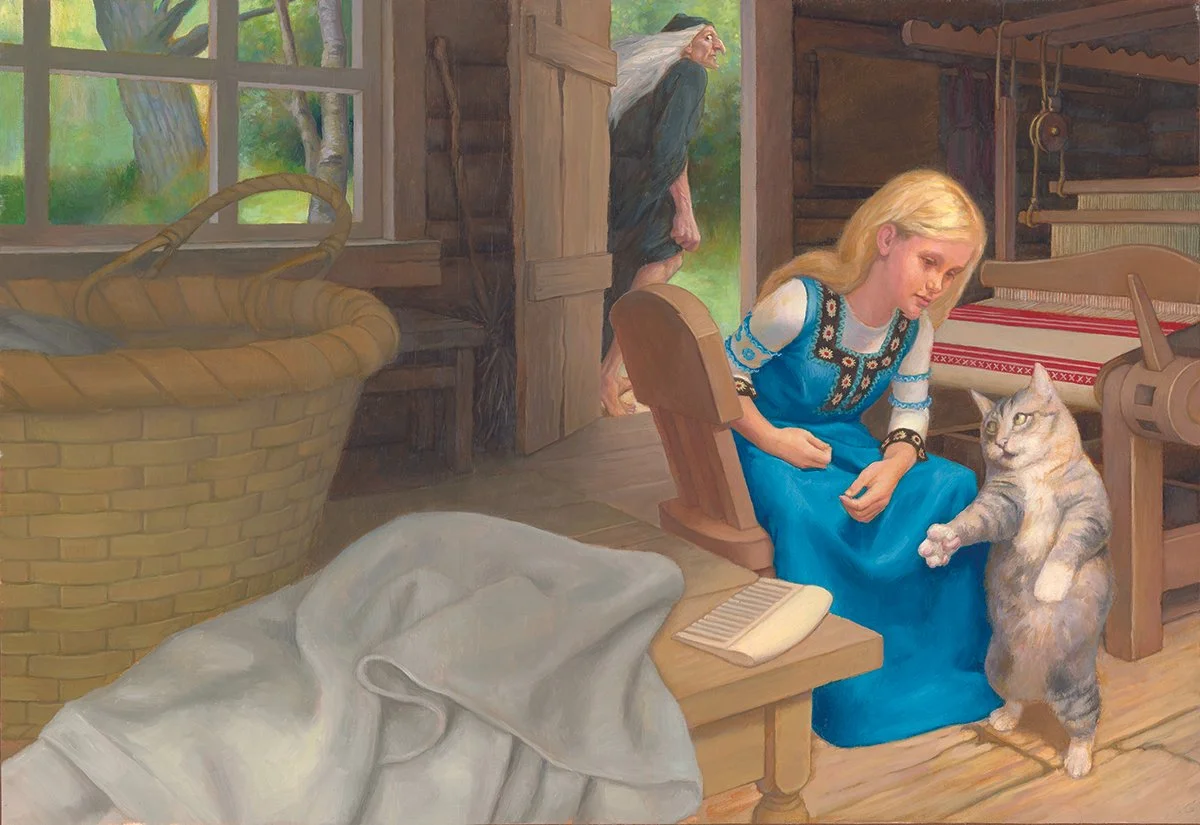
And by the way, I ended up painting witches professionally!
When I think about what I loved as a kid and what I’ve become, I think I loved art forms involving stories – maybe that was a common denominator. Stories that moved you in the heart, that were magic. To me, magic is my goal with art, that feeling, recreating that magic we felt as kids when we watched movies, or read Batman comics, or watched those Rankin Bass stop-motion animation Christmas specials. It was all magic-making. I loved that stuff. Halloween? Same. I realize now that I loved forms of art, whether it was film or animation or drawn pictures with a story attached.
As for early influences, comic books and animation were my early exposure to art, like for most American kids. I remember loving the sinuous line work of how Dick Giordano drew Batman comics in the 70s.
A big a-ha moment for me was Marc Davis’ concept sketches for the Pirates of the Caribbean ride at Disneyland. I remember seeing those sketches and thinking, people do this. I could do this. Marc was one of the “9 Old Men” animators and artists who were responsible for the early Disney animated classics of Snow White, Pinocchio, and so forth.
I got away from art for a few years and played a lot of sports. Then in high school, my art teacher introduced me to the Brothers Hildebrandt’s Lord of the Rings art which had a big influence on me. Greg and Tim Hildebrandt (they were twin brothers, I interviewed Greg a few years ago) were, like Marc Davis, a living example of someone walking a path I might take. The Hildebrandts were the guys who I looked at and said, “that’s what I want to do.” I then learned who their heroes and influences were — N.C. Wyeth, Howard Pyle, and Maxfield Parrish. Then I branched out and discovered the rest of art history, the Old Masters, the Renaissance, and by then I was hooked and off to the races.
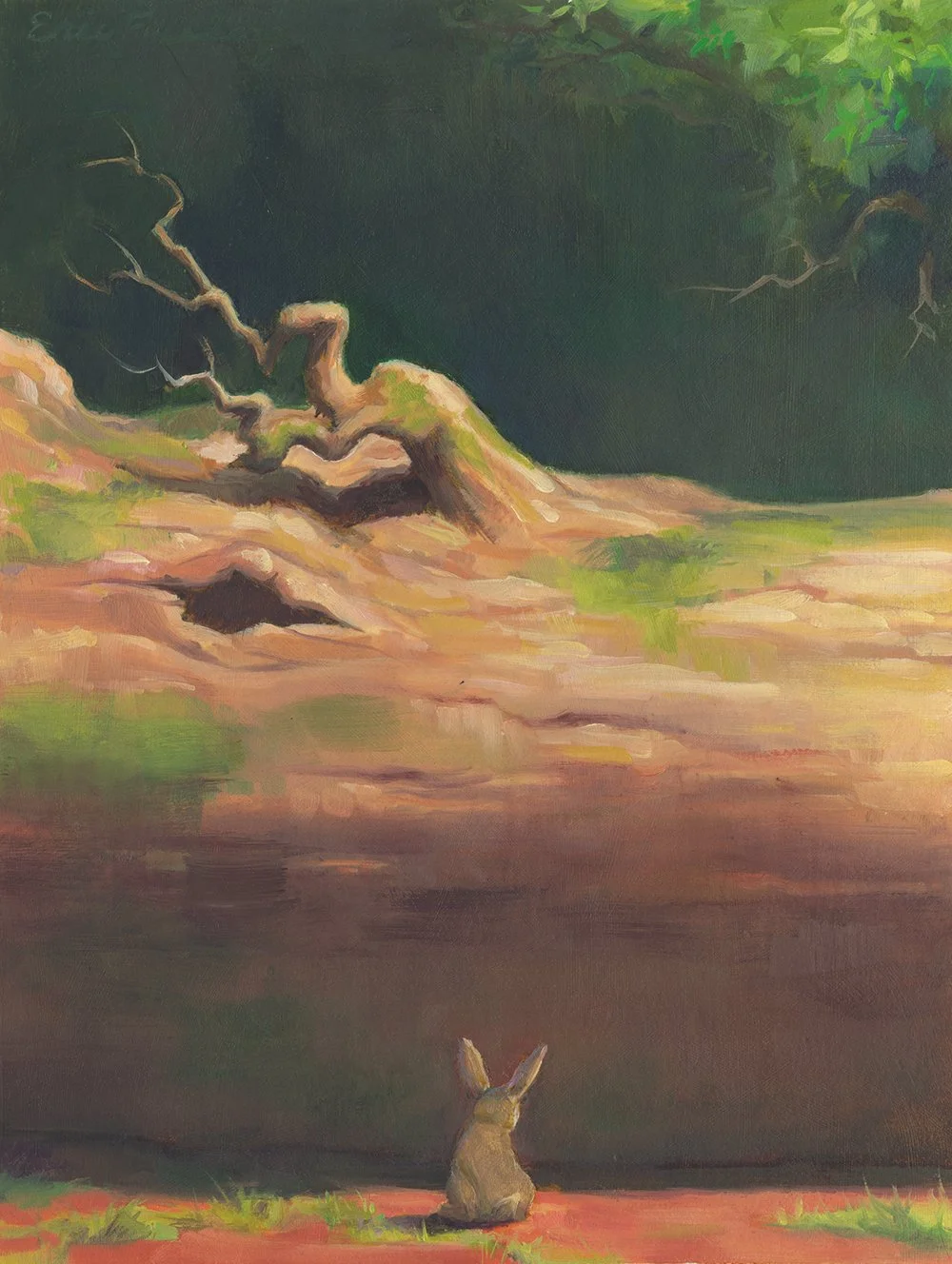
Bunny’s Obstacle
Talk about your instructional process? How has being a teacher informed your own creative path?
I’m not sure how to describe my instructional process. I think I try to meet students where they are and give whatever instruction is appropriate.
Teaching has definitely informed my own art. There’s the Aristotle quote “True understanding comes from teaching…” Teaching deepens my understanding of topics because I have to communicate the ideas to students clearly. Also, the way Ringling has me teach first year subjects includes information I wasn’t exposed to as a student, and that information has improved my own art. Some of the ideas we cover are ideas I wish I’d known about before I started illustrating.
Additionally, one of my duties at the art school is heading the Visiting Artist program for the first year students. When I host artist events, I and the students get to ask whatever questions we want about the guest’s experiences, attitudes, techniques, business and marketing tips, etc. The guests I invite tend to be among the best in their fields, so I, admittedly selfishly, get to learn from them, and because I host the events, they get to know me and it’s an opportunity to develop relationships. I’ve become friends with several of the guests and I think those relationships are making me better. I know that wasn’t the question, but the total experience at Ringling feeds my teaching and my art in a positive way — that’s what I’m trying to point out.
If you could instill just one single aspect of your instruction/philosophy in your students, what would that be?
I tell students the most important characteristic for success as an illustrator is to be self-motivated, because once you leave school it’s all on you. I guess work ethic is baked into that too, so I also talk to students about the 10,000 Hours Rule. It’s from a sometimes misunderstood or misinterpreted study that came out in the recent years, popularized by the writer Malcolm Gladwell. In the study, experts in various fields were asked how many total hours of practice, or concentrated practice, they’d put in over the years honing their craft? And the number 10,000 kept coming up. I think they asked the Beatles, Bill Gates, etc.
The lesson is there’s a lot of work that goes into mastering a discipline, and that putting in the work is more important than talent. You need some talent to develop, but work is more of a determining factor for success.
I think that’s true. But what I’d add to that is, first, if you’re working on something for 10,000 hours, you need to love it, or enjoy it at some level. Otherwise, you’ll quit, and if you don’t love it, you probably should. Second, 10,000 hours of practice means it’s a long term commitment. It’s going to take maybe 7 or 10 years. It means being patient. If you don’t have success straight out of school, which takes 4 years, that’s to be expected. You keep practicing, improving your portfolio on your own time around whatever you’re doing to make a living.
And lastly, you have to have enough self-belief to keep going, putting in your hours, when things are going your way, when you inevitably fail along the way. Growth mindset is what that’s called nowadays.
Related to 10,000 hours, I also suggest working by hours. Many freelancers I know, including myself, other artists, and writers, work by hours per week rather than waiting for inspiration or whatever. I keep track of and have targets for how many hours I work on art per week. John Grisham, Stephen King, Roald Dahl, all did something similar.
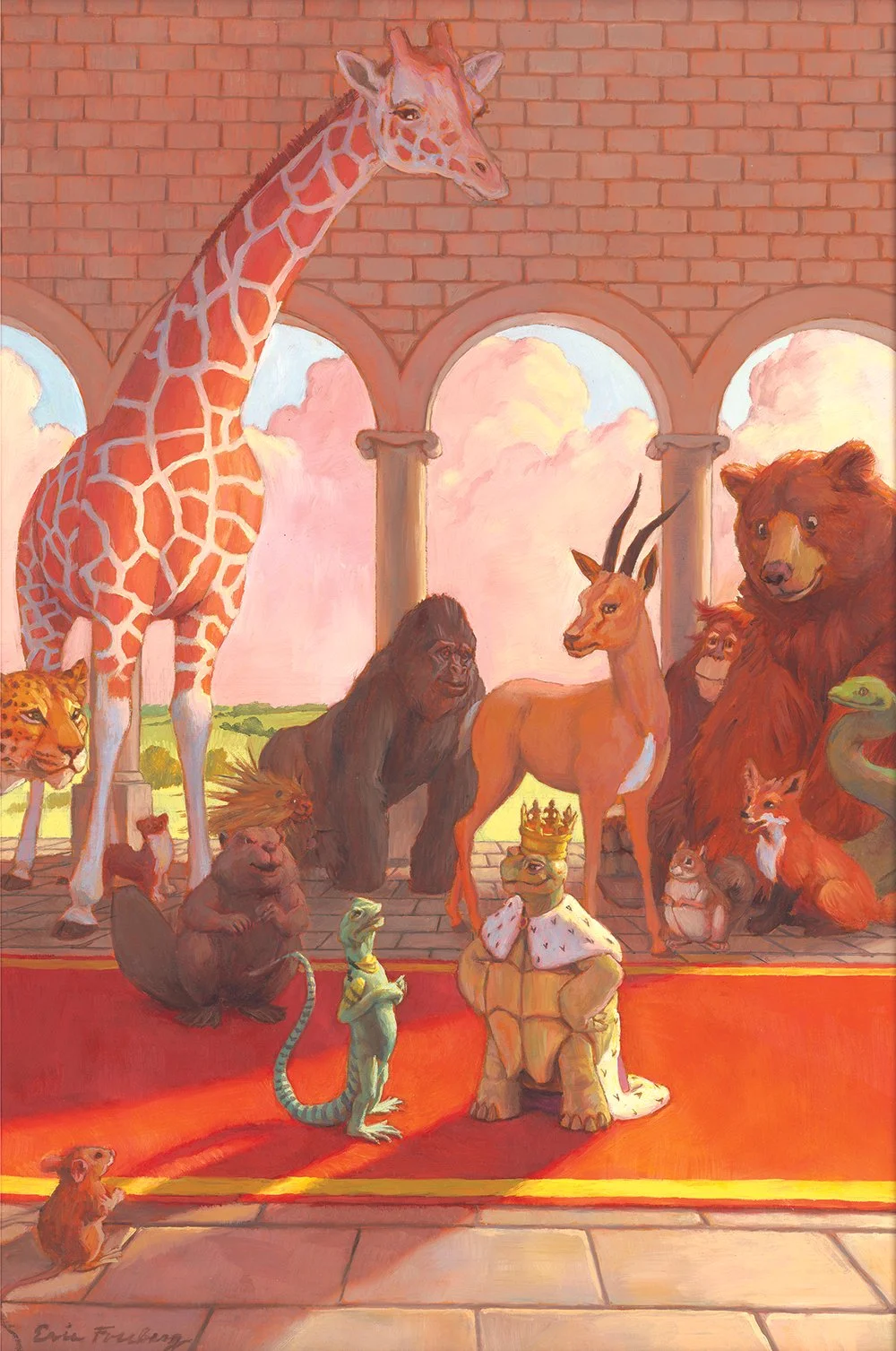
King Kudu talks to the Winner
What were some of your first professional projects? How did you find work when you were just beginning to build a name for yourself?
My first book illustration job offer was “White Fang” by Jack London for Compass Publishing. I ended up illustrating several classics for them, including “Tom Sawyer,” and “The Oblong Box” by Edgar Allen Poe, and the Russian folk tale “Baba Yaga.” I did a lot of work for that publisher early on.
I did a couple of jobs for Humpty Dumpty magazine. One was a story about George Washington’s adopted daughter, Nelly Custis, and another was titled “Fit for a King” about a king lion dissatisfied with the food he’s being served. I received the Honorable Mention Magazine Merit Award from the Society of Children’s Book Writers and Illustrators for those pictures.
Getting an agent was the start for me. As soon as I got representation, the offers started coming in. If an agent is willing to represent you, they believe you’re marketable, are making professional level work, and you’ve basically been vetted by someone who has working relationships with publishers. Once I was agented, I developed relationships with several publishers, and also started receiving offers independently outside of the agency.
What mediums are you mostly working with?
Oil paint when painting, and graphite pencil for drawings.
While your career seems to be largely involved with commercial work, I don’t think anyone would disagree that your paintings are fine art. Talk about some of the differences between illustration and maybe a piece that was created solely for you, or for a gallery wall.
I appreciate you saying my work is fine art. I think that’s probably a reference to quality. The labels of “fine art” and “commercial art” are tricky, in that they can mean different things to different people. Fine Art can refer to the freedom to do what you want, rather than for someone else’s purposes or for making money. I would argue a professional artist makes a living, and that means making money. Renaissance artists painted for clients almost exactly in the same manner as how I’ve created pictures for publishing houses. Maybe it’s just semantics.
I decided, 2 years ago, that I was at a point where I had grown tired of constantly meeting deadlines and I wanted to devote time and attention to my own children’s book ideas, which was always on the back burner when I had paying jobs to complete. The majority of my income was from illustrating. Accepting a full-time teaching position has allowed me to do that.
And it has also allowed me more time to exhibit in galleries and sell work. Relatedly, with illustrating I often felt I could improve the pictures if I had more time. With gallery shows, now I can devote time, when I wish, to taking paintings from books I illustrated and raising the level of quality to what I would call show, or museum, quality. It’s been a joy doing that. There’s a painting in the WVC show of the Wicked Witch giving orders to the leader of the Winged Monkeys to go get Dorothy that I had a lot of fun improving. I simply didn’t have the time, with my original deadline, to paint that picture as fully as I can now. That picture is one of the pictures I’m most proud of in the exhibition. So in a way, it’s combining doing it for the publisher followed by doing it for myself. I thoroughly enjoyed illustrating The Wizard of Oz so I think, with me, commercial work is just as joyful as something solely for myself. At this point in my career I lean toward doing what I want to do when I want to do it, and am more selective with job offers, but illustration jobs can be satisfying too.
I didn’t have time to scan it and share online before mailing, so it’ll be fun to see people’s reaction.
Talk about your process from start to finish. How much sketching, refining or plotting are you typically doing before you start committing to the final work? And how much of this stage of the process (if any) involves input from your clients?
With established publishing houses like Barnes & Noble, you’ll be given the manuscript of the book with very specific art direction of what they want. It might not, at first, seem very creative when art direction is so specific, but it actually is. You still have complete freedom with the style and look of the characters, the point of view, the lighting, the composition, the facial expressions and body language – everything.
With book illustration, contractually you’ll be given a sketch deadline and a final art deadline. You get paid after completing each. My favorite type of contract is when you get a payment for just agreeing to do the job, ha! But more often than not it’s the former.
I’m in the habit of providing 2, 3, or even sometimes 5 or 6 sketches for each illustration that the art director can choose from. One of my favorite things about illustrating is this stage, where you can riff on ideas of how the illustration could be composed. That’s one of the reasons I tend to offer multiple options, is I like doing them, but the art director also appreciates it. That said, almost invariably they’ll choose the sketch you like the least! So you might want to just give them the option you want to do.
When developing sketches, I start with “thumbnails” which are very small, almost abstract compositional sketch ideas. I then overlay a piece of tracing paper on top of the thumbnail, and with reference material (like character sketches, etc.) make another sketch on top of the thumbnail with more information and detail. If the art needs some realism I might photograph a model in costume as part of my reference material. That can be fun – I’ve recruited kids from local theater companies to pose for me with their parents nearby.
I’d keep doing tracing paper overlays until I’ve reached a level of quality that I’m happy with.
There’s a separate technique I use a lot – sculpting small maquettes of characters for reference. When I think it’d be helpful, I’ll make a little sculpture of a character, then paint it in acrylic. I can hold it up in the lighting and position needed in the various pictures which helps me to achieve character continuity and also a realism that you can only get when observing actual light falling on an object, as opposed to working from your imagination. Even if you have a great imagination, I find there’s no way to imagine the detail and lighting you get when working with a physical object. There will be several paintings of a leopard family in the show. I made little sculpted heads of all the leopard family members to aid me in making the 30-something paintings for that book. I learned the technique from James Gurney who illustrated “Dinotopia.”
I was thinking it’d be fun to have the sculptures in the show as well, but I’m afraid there isn’t enough time.
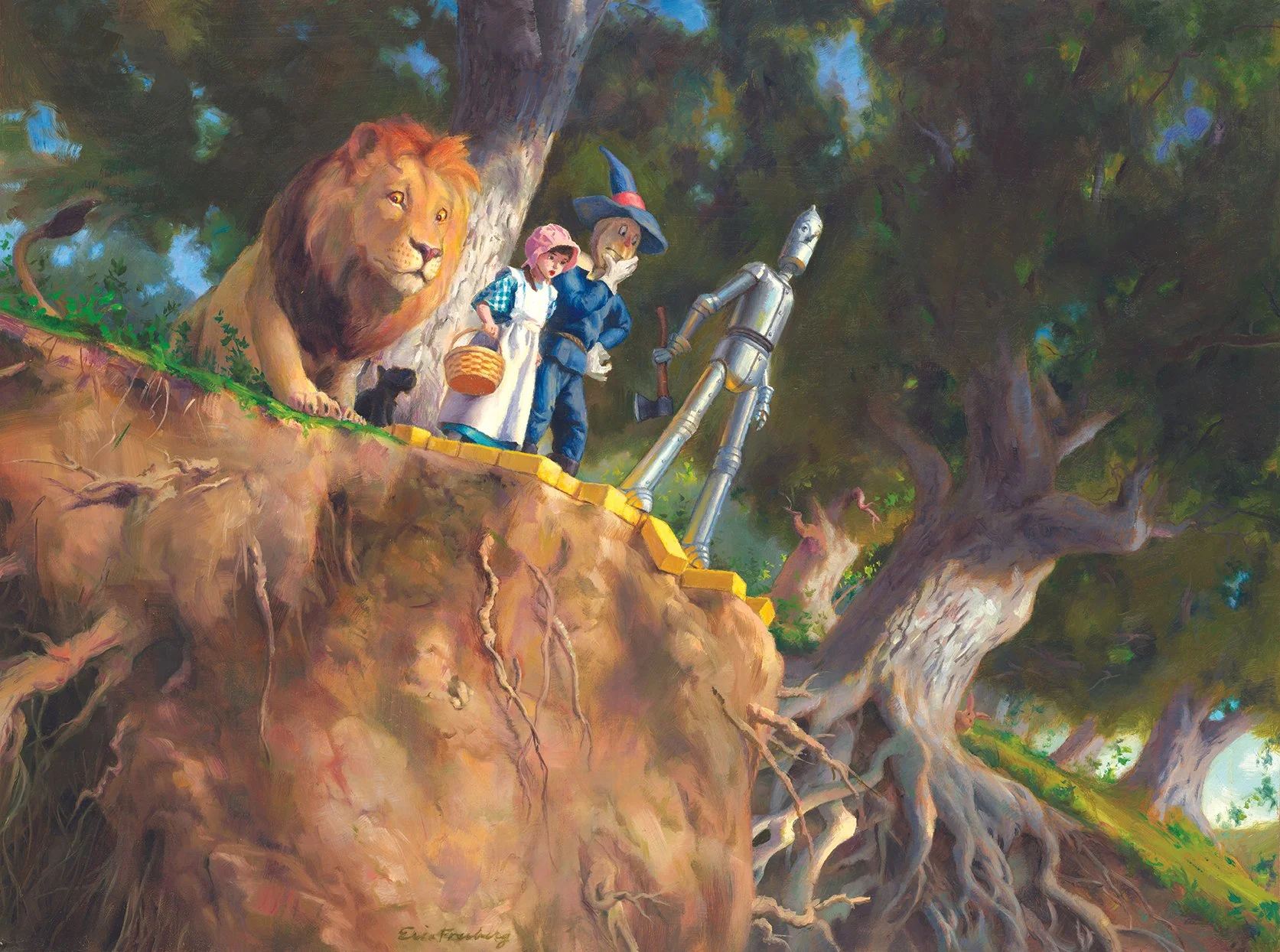
The Yellow Brick Road Disappears
On the topic of working with clients…this can be a two-edged sword and at times stressful. I think many artists would struggle with this unique element of commercial illustration. Talk about that process a bit. Favorite kinds of clients? Any kinds of projects (or clients) you try to steer clear from?
The client, at least for me, has mostly been publishers who know what they’re doing and are professional, so there’s rarely any difficulty working with them. If an author reaches out to me directly, I’m supposed to defer to my agent. When you illustrate a classic story, the author isn’t an issue, so it’s been easy. A book I illustrated won the Colorado Book Award for children’s literature last year, but the only time I interacted with the author was to congratulate her. That’s typical — the relationship between writer and illustrator tends to be very separate.
If an individual commissions a painting, that’s different. I explain the contract and how it works so there’s no confusion.
Did you ever have to submit a work you weren’t 100% happy with but maybe the client said “perfect!”?
Almost every time! No, actually you will often get notes about changes to make, which I’m happy to do because the goal for both the illustrator and the publisher is to make as good a book as possible. Early advice I got from an illustrator I admired was to have higher standards than the client. And the artist tends to be more aware of imperfections because you’re butting your head against them while making the picture. My name is going to be on the book, so that fact tends to push me to provide as high a level of quality as time allows. And your reputation and future job offers, especially from that publisher, will depend or be influenced by how good your work is.
Your illustration work often has a very storybook feel with an almost familiar (in a warm and welcoming way) resonance while still being unique to your own aesthetics. Talk about developing your own style while working in an industry that likely has certain confinements or expectations.
You framed it perfectly, in that you want to do work that’s in the style you like — your style — but there’s also the prevailing general trend of what’s being currently published. It’s a balance between being true to yourself but aware of trends. If I do work like what’s being published, I’ll get published versus remaining true to yourself.
Publishers will advise you to just be you, but when you look at what they’re publishing, some of them seem to be following the herd.
It’s a tricky line to tread. So far I’ve been fine. I paint like me and some people do seem to want it. I think it’s important to be open to growing, while remaining yourself. That attitude might be the sweet spot when it comes to style. I’ve evolved a lot. Hopefully I’m getting better. You’re allowed to change too.
How do you maintain a style while also being flexible enough for a variety of projects – that sounds hard to me!
Haha. My attitude is, I enjoy doing a stylistic range from what I’d call almost visual comedy on one end, to a classical style on the other end. I like doing both at different times. I have a sense of humor, too much of a sense of humor, maybe. And that can be fun to let loose on the stuff for younger kids.
Do you typically keep your originals for a book illustration? Is this all part of the contracts?
Yes. And it is, as you say, per contract. All the contracts I’ve had have allowed me to keep the originals. I don’t know if that’s the case in other genres, but in kids books I think that’s the norm.
It used to be illustrators didn’t get to keep their originals, which would suck. That’s why so many N.C. Wyeths and other Golden Age illustrators’ work is still floating around New York city in collections.
I tell students one of the cool things about working traditionally with paint rather than digitally is you have original art you can sell. You can also sell prints, limited edition prints, etc. It’s an additional income stream beyond what you receive from the publisher.
Do you have a dream illustration project?
I’m developing a book dummy for a lesser known Grimms fairy tale that I’ve been hoping to do for a long time. I illustrated “Grimms Fairy Tales” for Barnes & Noble, but this particular story, as far as I can find, hasn’t been done more than a couple of times, and never that well, in my opinion. And it’s a strong story. So that’s a project I’m nibbling on, in addition to raising the quality of illustrations and developing new pictures for gallery shows. One of the paintings I’ve done for this book dummy will be in the show. I’ll be sharing it online this week.
Has AI started to have a noticeable impact on the business of commercial illustration? Share your thoughts on navigating this strange new era of instant “art.”
It undoubtedly has, though I have to say, it’s not having a huge effect yet, not in kids books. Not in terms of taking away work. I think it can be a great tool as part of your process. I like to point that out because most people, or most students, take a completely negative stance toward AI.
I think I’m more relaxed about it because I’m well along in my career whereas college kids may take the brunt of whatever’s coming. People in the publishing industry freak out every few years about a perceived threat that is then completely forgotten a few years later. That won’t happen with AI – it’s major. But we should all be reminded, change is always happening and that’s all AI is, another change.
As I wrote earlier, one of my favorite duties at Ringling is I’m in charge of the visiting artist program for the first year students. I hosted an artist who does concept art of the spaceships for The Mandalorian tv show and many of the Star Wars movies. When I asked about AI’s impact on his work, his response was it didn’t affect him at all. He said when he was just starting out HE was the threat to the model makers of the X-Wing fighters. You can always find a threat if you look for it, was his point. And he was similar in age to me, which is to say, when you’ve lived long enough you’ve seen problems arise and then get absorbed and resolved — it doesn’t always turn out as badly as your emotions fear. Change is the nature of things, so calm down, it’ll be fine. But I realize it’s easy for us to say because things worked out for us.
AI aside, any other major changes or impacts you have seen in this field over the years?
I don’t know about any other major impacts. I’d say the work being done is slowly starting to become more digital. If you ask publishers, they don’t care how you created the illustration — they actually prefer it to look like traditional media and don’t care whether it’s been created with a paint brush or a laptop. That might be a surprise to the average person.
When I looked at “The Original Art,” a curated show of children’s book art at the Society of Illustrators last summer, I counted about 25 percent of the pictures were painted traditionally, and the rest was split between being a hybrid of traditional and digital media, and entirely digital. So basically it confirms what the publishers were saying, that you can create illustrations in a way you prefer, as long as it’s good. Procreate was the most common digital platform used for painting. It’s becoming a really common tool for digital painting because the young guns coming up are using it from an early age. I suspect Procreate might take over because these younger artists aren’t as facile at traditional drawing as they are drawing on an Ipad. Not a big sweeping change, but I’m interested.
Tell us about this upcoming MAC show here in Wenatchee. Will you be here for the opening? If so, any plans for a lecture/Q&A or any other kind of presentation?
“Making a Living Painting Bunnies and Mermaids: The Art of Eric Freeberg” will open in the MAC gallery at Wenatchee Valley College on March 6th, 5-7pm.
The show is a sampling of work I’ve done over my career as an illustrator for various publishing houses, along with recently created work. Work in the exhibit for classics such as “The Iliad,” “The Odyssey,” “Great Expectations,” several large paintings for “The Wizard of Oz,” “Grimms Fairy Tales,” “Journey to the Center of the Earth,” “Tom Sawyer,” “Greek Myths,” and “Roman Myths,” and Edgar Allen Poe’s “The Oblong Box” will be included.
I did a kids book for the National Parks Service raising awareness for the plight of the Red Wolves population. The cover painting for that book is in the show.
Additionally, I illustrated 6 easy reader books (Berenstain Bears are easy readers, for example) for the Kudu Adventures series. Several paintings I created for those readers will be in the show, as well as many other jobs.
The title of the show was what I got in the habit of telling people when asked what I do for a living, because at one point I literally was painting bunnies and mermaids for 2 different book jobs, and I thought it sounded funny.
Yes, I’ll be in Wenatchee for the opening on March 6th, and I’ll be in town through the 15th.
I’ll be doing a Powerpoint presentation of my work at the opening that I usually give to 5th graders, with some slight alterations. There’ll be a Q & A.
I need to touch base with the high school, but I agreed to do a talk and demonstration for students there some time in the following week as well.
Where can people follow your endeavors online?
You can find me at ericfreebergillustration.com. To be put on my mailing list if you have an interest in buying a painting or prints, message me through my website, or email at ericfreebergillustration@gmail.com.
Making a Living Painting Bunnies
& Mermaids
WVC MAC Gallery
March 6—April 24
First Friday Opening Reception:
March 6, 5:00—7:00 pm
Presentation by the Artist in the MAC Grove: Friday, March 6, 6:00 pm