
‘COMMON GROUND’ HITS THE SNOWY OWL STAGE
By Ron Evans
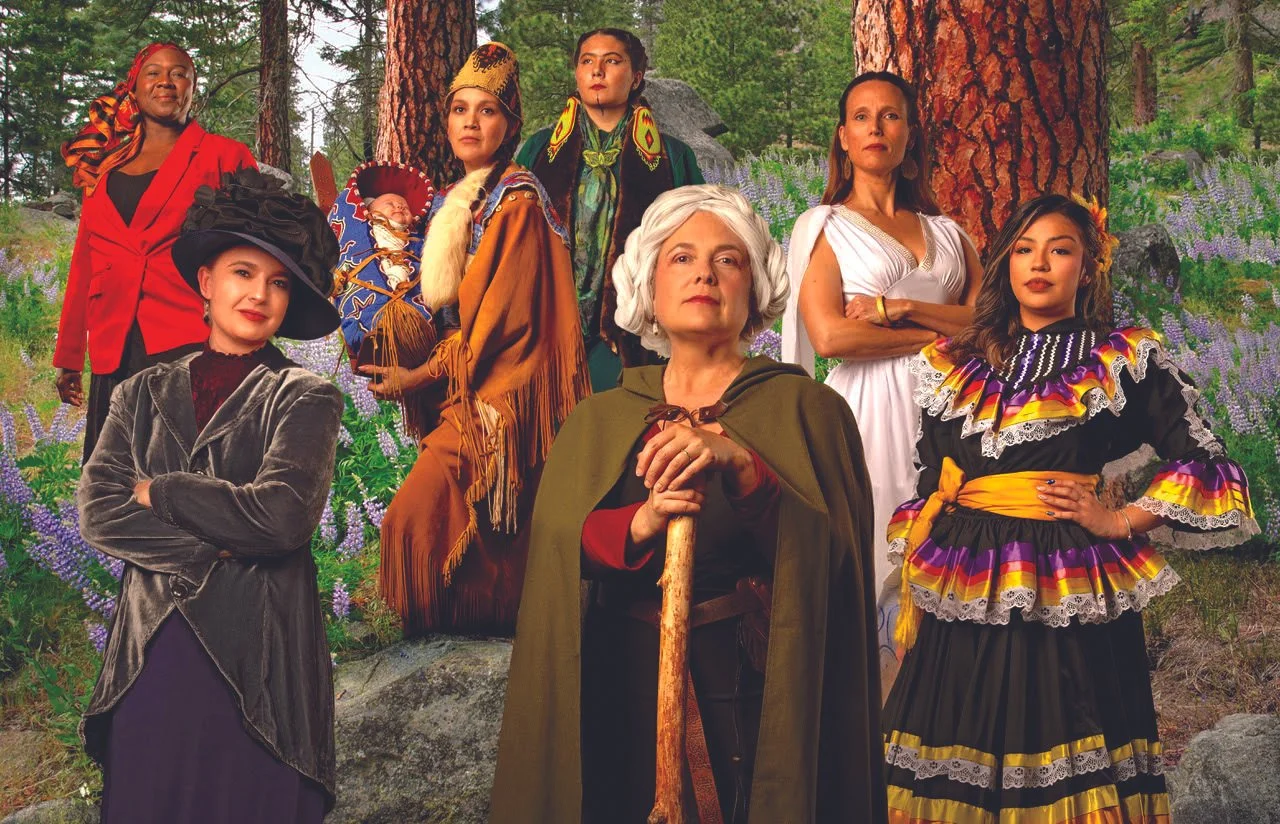
Ten years in, Dangerous Women remains one of the more intriguing and vibrant things happening on any stage around here. Part history lesson, part theater experiment, part rallying cry—the Leavenworth-based collective has built a reputation for bold, locally created productions that mix performance, music, movement, and big ideas. Their newest show, Common Ground, opens this month—and after talking with director Rhona Baron, it’s clear these dangerous women are just getting warmed up.
For readers who may not know, give us the brief history of Dangerous Women.
This is the 10-year anniversary of Dangerous Women. The group started as women’s history short segments at Faith Lutheran Church, when Susan Butruille and Mandy Wickline presented women’s history vignettes during March, Women’s History Month.
I got involved in 2016, the first year the small cast moved to Snowy Owl Theater. I became director in 2017 and saw an opportunity to do a kind of theater that was unique and powerful and unusual.
We became a nonprofit in 2018, and we’ve been growing ever since—in diversity, in theme, in research, in writing, in art forms, and in casting on stage.
The shows are all locally written and produced. How does the writing process work? How do you assemble your Dangerous Women each year?
The cast and crew are unusual in that it consists of women creatives who are community leaders, visionaries, and about 75 percent educators. We have 10 directors in the show, and it’s not unusual to have women who lead or teach be the backbone of the group.
We’re nontraditional because we collaborate and write and workshop to bring scenes to life with our complementary ideas and art forms.
My job as director is to hold it together—to identify people’s strengths, pair them with the right partners, and manage all the art forms that are emerging, along with all the personalities. My degree is in visual art, but I’ve also worked professionally in pretty much every art form we have on stage. That allows me to step way back and see the big picture as the show shapes itself.
How do you decide on themes? Is each show built around one singular idea?
We take a year to build a show, and then we run the show for two or three years. We’ve just been building this new show called Common Ground, and we’re going to debut it on the 16th and run it three times that weekend, then again next year.
When we run it again, it will be modified based on what we see and learn. Our process is a lot of throwing spaghetti against the wall. Most of that happens before we get to the stage. It’s like birthing something brand new. Once the child comes to life, we nurture it the following year and may dress it a little differently.
Themes usually just feel right to the group. We meet every November and review where we want to go next. This particular theme is our most existential and controversial, in that it’s not just about history—it’s about what we’re going to do, what choices people decide to make with the natural world going forward.
The name Dangerous Women is fantastic. It’s provocative without being too aggressive. Have you had controversy over the years?
Throughout history, women have been labeled dangerous when they challenge the status quo. Our definition of dangerous is inspired by Jane Addams. She was branded the most dangerous woman in America in the 1920s because she was a pacifist dedicated to social justice for the poor. She later won the Nobel Peace Prize in 1931.
When we say we’re dangerous, we’re dangerous because we ask hard questions and think them through. We bring parts of history to life that are glorious and also gory.
We try very hard to tell stories without a strong political bent, and we’re successful at that partly because we have multiple cultures, ages, and viewpoints within the cast. We balance each other.
Deep down, we’re about healing. Sometimes growth and change are dangerous. But we’re really about reconciliation and healing.
Talk more about the art forms you incorporate—especially in this upcoming performance.
We always have traditional drama on stage. That can be scenes with multiple people or one character brought to life through a monologue. We always have singing, dance instrumentation and music. We always project historic images.
I also remix professional soundtracks used in movies, television, and radio to create musical landscapes that flow through a production.
We’ve had visual art, poetry, modern dance, swing dance, belly dancing. This year we are having pole dance as an art form. In that piece, our pole artist will take us on an ocean journey suspended on her pole to honor the strength of women in the history of ocean sciences in the early 1900s.
I’m open to using art as richly as possible throughout our shows.
In this production, people will hear Indigenous stories in the language of the local people delivered by Indigenous performers. They’ll see Latina butterflies dance and meet women from history like En Heduanna, an ancient Sumerian astronomer.
The show is full of unexpected, life-affirming, educational theater arts. We also do a talkback afterward, and sometimes people stay for half an hour discussing what they’ve seen.
Are you always looking for new people to get involved?
Right now we’re too close to the show to onboard new people. Long term, we’re always interested in hearing from women interested in collaboration. We’re not a place for divas. We collaborate. We support each other. I believe that’s a more feminist model of organizing people.
How do you fund something this ambitious?
I’ve been very successful with grant writing. We’ve been supported by about 10 granters, including ArtsWA, the Community Foundation of North Central Washington, Icicle Fund, the City of Leavenworth, Chelan County, Indigenous Roots and Reparation Foundation, Woods Family Grant and the Community Accelerator Grant started by one of the founders of Microsoft.
Those grants have really allowed us to move to a different place. Without grants, we could never do what we do with donations and ticket sales alone.
I’m also very firm about compensating everyone something. I don’t want anyone to lose money or just volunteer for doing our shows. Artists need to be appreciated financially, even if it’s only a little bit.
Is your relationship with Snowy Owl a partnership?
We rent the theater, but it’s a partnership in that we share ideas and know each other well. I have to give a shout out to Eric Frank, their tech director. He understands how we work—historic projections, lighting, sound, microphones, all the moving parts. He’s fantastic.
Have you thought about expanding beyond one annual run in Leavenworth?
Yes. Dangerous Women has considered moving to a bigger stage. We’ve approached Numerica PAC in Wenatchee. More recently, there seems to be interest from a theater in Seattle, and we’re taking a look at what next year might hold.
I think we should be in Seattle, and I think we should be in Olympia too. We need to think carefully about where the brightest future might lie for us. It may be a small, intimate theater in Seattle rather than trying to make it bigger in Wenatchee. I don’t know the answer yet.
We want people exposed to what we’re doing. It’s a passion project with longer implications for people who see our shows. We’re creating something thoughtful, collaborative, and unlike anything else we’ve heard of!
Dangerous Women: Common Ground
May 16 2:00pm, May 16 7:30pm,
May 17 2:00pm
Snowy Owl Theater, Leavenworth
Tickets: icicle.org