
AN ORIGINAL MUSICAL TAKES SHAPE FOR HOT AUGUST NIGHTS
By Ron Evans
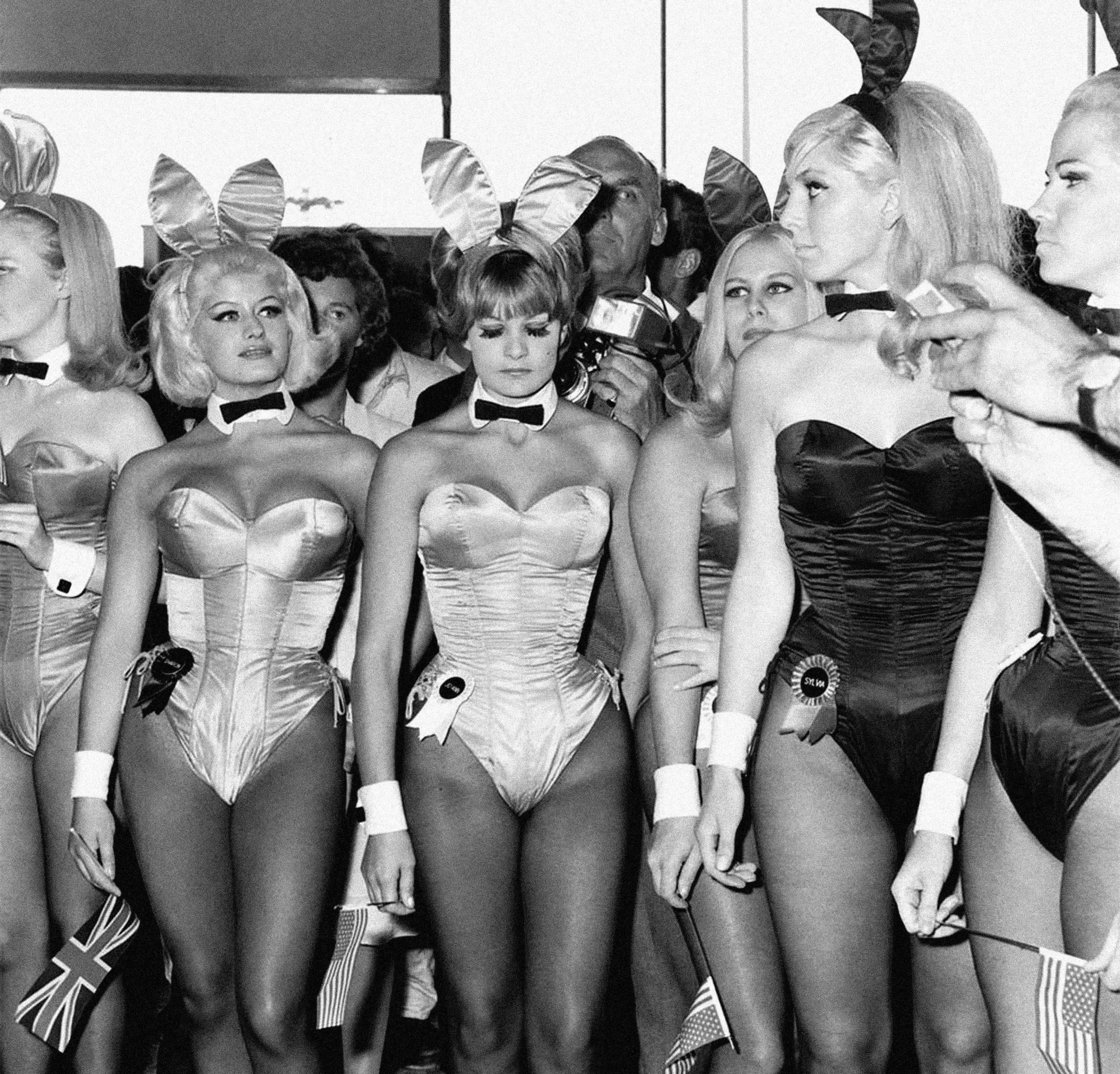
For the first time in its history, Wenatchee’s Hot August Nights will present an entirely original musical, developed by longtime Hot August Nights collaborator Bethany Christine Elkin and composer Justin S. Fischer, with producer Jaime Donegan. Years in the making, the production explores the women, politics and cultural upheaval behind the bunny empire. I sat down for a Zoom chat with the creative team to talk about finding the story, writing the music and bringing a brand-new musical to the stage for its world premiere in Wenatchee.
Upon logging on I hear Bethany talking about “the grandma story.”
RON: So are we starting with the grandma story?
BETHANY: Sure. Well, I think we can start with the origin of the piece itself, which includes the grandma story. So, I was in graduate school, and in 2012, one of our final capstone projects was to create a new musical, and we were supposed to come up with a theme. We were supposed to come up with a storyline. Who we would want to direct and choreograph it. Who we would want to cast. And basically, we were tasked with putting together a pitch for producers for a new musical. And it could be about anything. There could be source material, or not. Whatever. So naturally I was like, “Well, I need to do something really saucy and fun, and I want it to dance.”
I’ve always loved Playboy. I’ve always been really intrigued by it, in large part because of the nature of Playboy, but then also my grandmother Ollie. When I was a kid, she used to buy Playboys in my grandfather’s name, and keep in mind they owned a funeral home. So I come from a crazy land.
So anyway, she used to order Playboys in my grandfather’s name. They’d come in the paper bags. She would order them for the jokes, and she would tell the jokes to the ladies at the parlor when she was getting her hair permed, and as a kid she would sometimes tell the jokes to me.
There was one distinct moment. We were in the back of my van as a kid, and she was teaching me how to tie my shoes with the bunny ears. She was telling me this really raunchy joke about a parrot. I was always intrigued by Playboy. And later as I started reading about Hugh Hefner and the origin of Playboy, I thought there’s really something here, not just about Hugh Hefner, but about these women.
The women around him were really intriguing to me, and the people that were staples at the mansion. I was surprisingly taken by some of the material so I created a pitch for the piece, dressed up like a Playboy bunny, did my presentation, and then moved back to New York after graduate school and reconnected with Justin, and shared the idea with him. Then I shared the idea with Jaime, and the show eventually morphed into something totally different than what that presentation was. Thank goodness.
There was a nugget of something there, and, fun fact, there are actually three characters that we refer to as the Feminine Mystique, and they are each named after Justin and my grandmothers and Jaime’s mother.
RON: I love everything about that. So, Justin, forgive my ignorance. I have no idea how any of this works. I’ve talked to writers on just about every level and medium, but I have never talked about writing for the stage, which is a unique thing in and of itself. But a musical, especially. Does it start with the music? The words?
JUSTIN: So much of what I have written throughout my career has been me doing the script, the music, and the lyrics purely by necessity, because there just weren’t collaborators around who could commit to the work schedule that I was navigating.
But to speak to the process of the actual creation of a musical theater piece, you end up reinventing the wheel every time, and I say that because the creation of musical theater is probably the most collaborative art form in Western art. You need visual artists. You need people who specialize in movement. You need people who specialize in text and spoken language. And you need people who specialize in music.
And all those things need to come together, and they all need to be correlated, and they need to be driven by the same creative vision, which is why most musicals suck. [laughs] And on the occasion when they do work, you have this thing that sort of transcendently exists on all these different levels.
So you are reinventing the wheel the entire time, and a lot of that comes from the inspiration of that upon which you are working. In our case, I began researching and now, here we are.
William Goldman, who wrote “Butch Cassidy,” and “All the President’s Men,” and “The Princess Bride,” that’s the big one. With “All the President’s Men,” he talked about adapting specifically the first two-thirds of the book. And when we were navigating this element, it was a matter of - what are we going to focus on? What can we excise? I had these thoughts as I was engaging with the material.
There’s a very specific point around 1975 where the story changes dramatically, and you see the rise of publications like Penthouse and Hustler.
RON: The era of the Pubic Hair Wars.
JUSTIN: The Pubic Hair Wars, yeah, exactly. And it’s almost as if Hef’s focus at that moment really changes, and he feels like he has to respond rather than the guiding that he’d been doing for the previous 20 years. And that also sort of coincides with his girlfriend Barbi Benton leaving him, and it also coincides with him making the permanent shift from Chicago to Los Angeles.
So, similarly to what Goldman was navigating with “All the President’s Men,” it felt like that was a moment that was a clear endpoint that we could stop there, and the rest of the story is almost like a second chapter.
And it’s also, one of the ideas from a music composition element that bore itself out early on. I wanted to try and track the piece chronologically because as Bethany talked about the Feminine Mystique, this girl group of these three women who sort of act as our Greek chorus, taking us through 1953 to 1975.
And there were girl groups in 1953, and there were girl groups in 1975. And we can use the music to put us in specific moments, but also to move us forward, and so we can track things that way to the extent where you might hear a tune in Act One that’s played in a specific style, and it’s going to get rearranged for Act Two when we get the reprise because it’s in a different time period. So we can always sort of tell where we are by what it sounds like.
I think the reason that I write almost nothing except musical theater is because at my heart I’m more of a dramatist than I am a musical composer. If I don’t have the textual and the dramaturgical core to what’s happening, the music isn’t going to happen anyway. And so because in this specific project we’re talking about dramaturgy that is specifically tied to the moment, that inspires so many elements.
If I know that I have a scene that’s happening in June of 1960, that’s the scene that not only do I have to dramatize, but I also have to rhyme and I have to compose. I’m gonna go to the Billboard chart in June of 1960, figure out what—well, actually, I’m gonna go to the chart of April of 1960 and grab what was in the zeitgeist and use that to inform the musical language through which the characters are speaking.
And then it becomes more minute than that too, in the sense of the specific characters are going to be into different types of music. Hef was a big jazz guy, so he’s going to be more into jazz, whereas other characters will be into other types of music. So how does that inform what they’re singing?
RON: That sounds like a fun and exciting challenge. To work through different genres and eras of music while also maintaining a running theme and motif.
JUSTIN: The goal is to take a lot of very similar and basic source material and continue to develop it and continue to take it through the different styles.
I was actually having a conversation with somebody yesterday and talking about it, and what it really comes down to is essentially just theme and variations.You do it in one way and then you do a variation of it in a different way.
And Sondheim was a big theme and variations guy, and it’s that idea that we can, perfect example, we have a tune right now that occurs over the ’50s.
So the first verse she sings in proto-rock R&B kind of a situation, and then the next verse literally happens a couple years later. So suddenly we’re into very early rock and roll, Carl Perkins. And then the third verse, the biggest verse, happens a couple years after that. And now we are into full rock and roll, and we’re doing Jerry Lee Lewis, and we’re bringing the ensemble in as backups.
So we get the same melodic harmonic content, but it goes through these different levels of arrangement. So hopefully we’re communicating the passage of time.
RON: Interesting. Well, I can’t think of any other art form where lyricism and the poetry of songwriting is also dialogue, other than a musical.
Talk about writing the actual words and going from spoken word into a song. That also seems like a fun challenge - to work within that transition out of dialogue into a song and back into dialogue, and it’s all just part of the fucking story.
JUSTIN: I think what it really comes down to is you have to understand the trade-offs that you’re making, which are dialogue is fundamentally about the communication of information, and lyrics are about the communication of emotion.
The audience is going to catch so much more when it’s spoken dialogue than when it’s lyrics. But when it becomes about the emotion that you have to communicate, that’s when you go into song.
And to be clear, this is not my idea or my philosophy. This is a quote from Oscar Hammerstein, and he said it much simpler than I’m saying it right now. And what he said was, “When things get too emotional to talk about, you sing, and when things get too emotional to sing about, you dance.”
And that’s essentially what we’re talking about, following that same sort of bell curve of a rubric, where when you have to communicate something where the emotion is trumping everything else, you have to sing about it.
RON: I want to talk about your writing process, mostly from a mechanical or environmental standpoint. Do you have a routine, a ritual, a laptop in a coffee shop? Are you always carrying around notebooks and jotting things down? Are you structured, or are you just writing shit down as it comes to you?
JUSTIN: What I find is that different types of writing necessitate different types of environments.
For whatever reason, I have found in the last couple years that I’ve been doing a lot of playwriting and screenwriting as opposed to just musical theater writing. And the nice thing about dealing with text, i.e., sans music, is you can kind of do it anywhere.
Obviously, when it comes to lyric writing, and then the music writing on top of that, that needs to be in more of a specific location.
Generally, I’m not going to successfully write a lyric if I have music in a coffe shop going on.
But generally speaking, what I would tell people is music stuff has to happen in the office, and textual stuff can kind of happen anywhere.
I almost always write lyrics first, and again, that goes back to what we were talking about earlier. At the end of the day, I’m more dramaturgical than I am musicological. So if I don’t know the story, then it’s really hard for me to write the music.
And what I find is when I write a lyric, typically by the time I’ve written the lyric, I know what the music sounds like, and it’s just sitting down at the piano and filling out the form.
And I’ve worked that way since I was 14, and it was literally a situation where up to that point, I was writing music first and then putting the lyric on top of that, and that’s totally valid. That’s how Billy Joel worked.
But I decided to switch because I had read at that moment that that’s how Hammerstein and Rodgers worked, where Hammerstein would spend six weeks crafting a lyric, and then he would hand it off to Rodgers, and Rodgers would write a melody in five minutes.
So, almost as a lark, I wrote the opening number for an adaptation of “The Pied Piper” that I was doing, and the lyric came out, and I knew what the music sounded like so completely that it was like, oh well, I don’t know how I could really work in any other way.
And again, I’m speaking for me personally. I wouldn’t presume to speak for any other writer, but it locked itself in so completely in that way that that’s how I’ve worked for the last, how old am I now? We’re like what, 22 years, 24 years, something like that.
RON: I’m really excited that Hot August Nights will be an original production this year. It’s an intriguing and rich subject matter and the right people are involved with it.
JAIME: I would just wrap this up with a quick thing from my viewpoint, and working sometimes by myself and sometimes with Bethany to do these Hot August Nights shows.
I typically don’t like to ever do anything that doesn’t scare me, and this is scary in its own right in a completely different way than anything that I feel like we’ve ever done.
I also love that it’s an original musical. I love that it’s my friends that are creating this amazing story and this amazing music. I am so looking forward to digging into this with Bethany and Justin. And some people locally, and some people that we bring in. We will be digging into it soon.
And that’s, I think, the beauty of what we are able to do with this type of production that maybe in the past wasn’t always available. That you were doing something to present a certain something to learn, or to whatever...to maybe garner some investments.
And it’s so exciting that Wenatchee gets to be the world premiere of this new wonderful musical, and I think that’s pretty cool.