
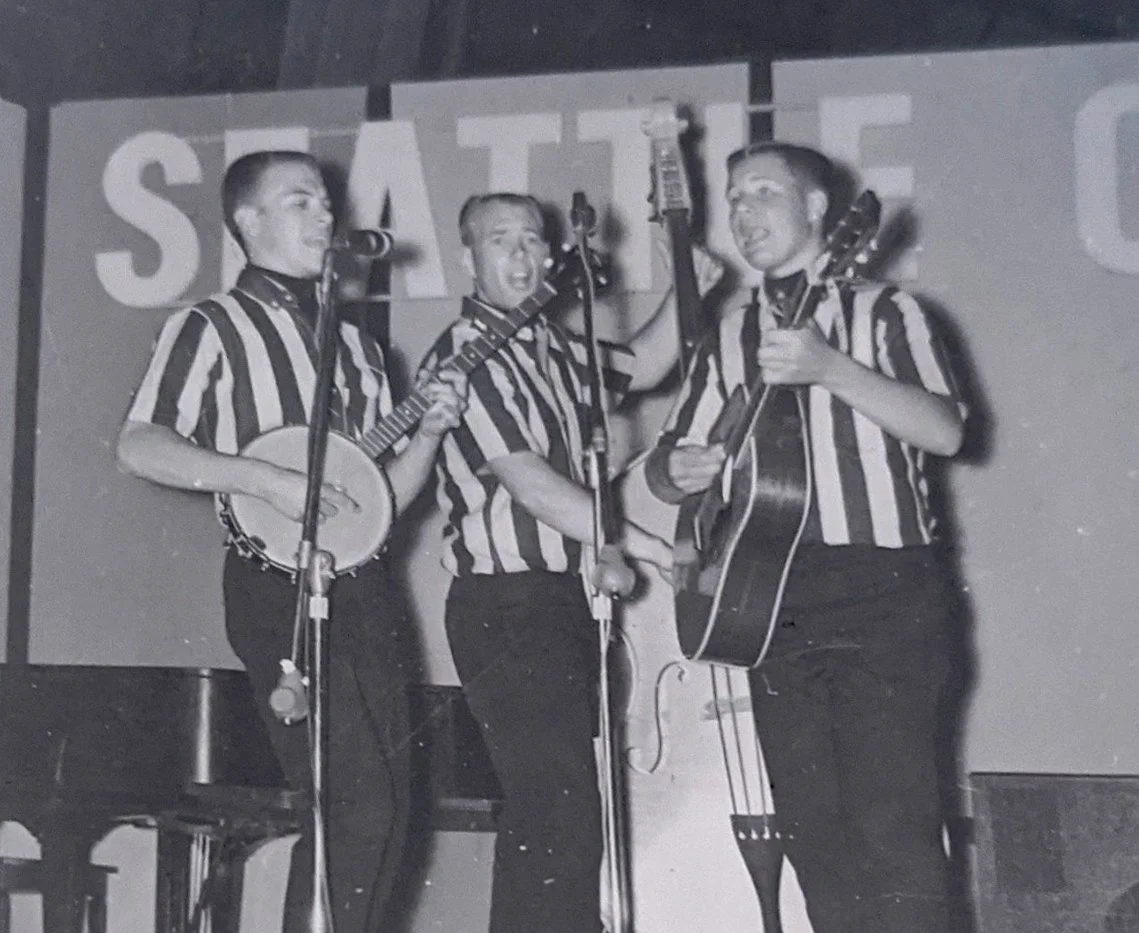
CORRECTION: This photo was miscredited in the print edition. This is the corrected info - - From L to R, Fuller, Kiehn & Davis performing at the Seattle Center, 1964. Credit: Richard Fuller
BY DUSTIN HAYS
I’ve stumbled across Wenatchee area bands from the past many ways: hearing stories from local concert-goers, name drops from musicians I know, mentions in newspapers, and occasionally finding an old record around the valley.
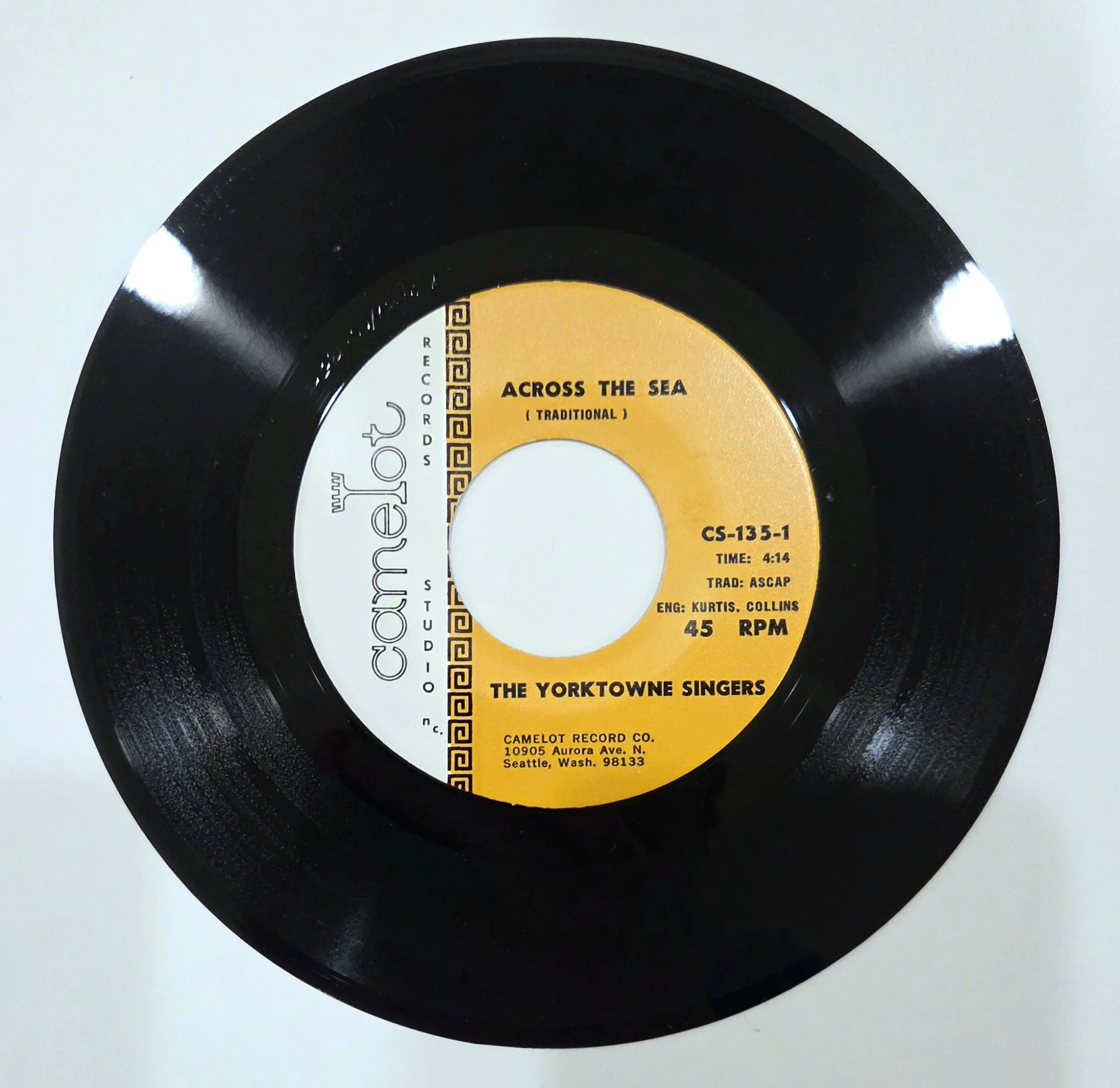
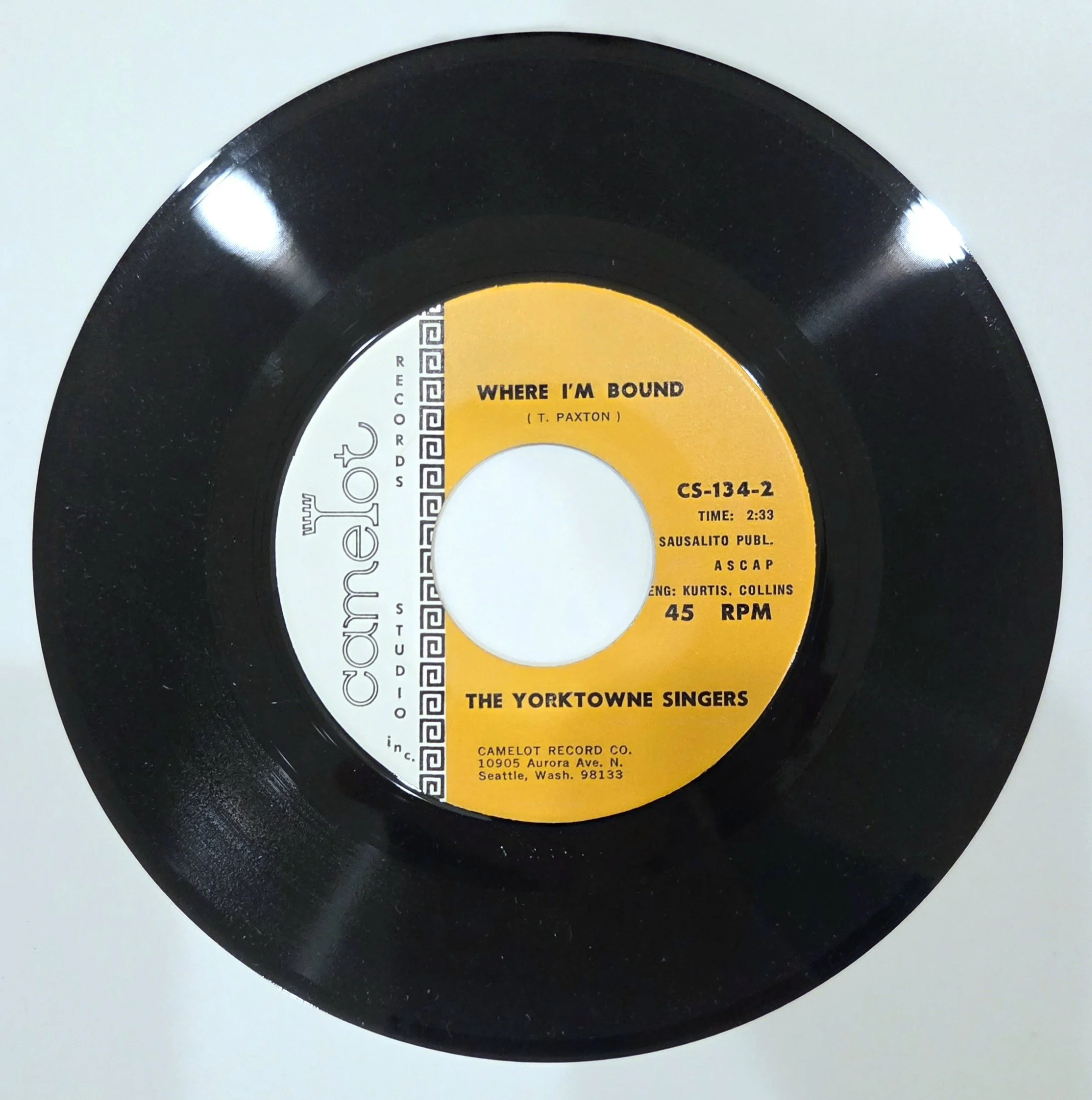
Back in 2017, I found a 45 record by The Yorktowne Singers at a yard sale in East Wenatchee. It was released by Camelot Records, a label run by hobbyist recorder Jan Kurtis out of Seattle, WA. I was familiar with a few records on Camelot — The Page Boys, The Deacons, and The Dorsals all had great garage singles I had found copies of, but this was a folk single that was totally new to me.
Soon after that, I found a business card, “The Yorktowne Singers - Peshastin, WA.”
HOLY CRAP, a group from Peshastin put out that record?! With that clue, I was able to dig up an obituary from 2012 for one of the members, but then the search hit a dead end. A few years later, I happened upon a photo at the American Legion Hall in Cashmere, of the group performing a Christmas concert in 1966, but there were no more leads. As time went on, I figured I would never learn more. Of the two singles they released, I had one. Maybe that was enough…
Then, last winter I decided to finally get to the bottom of it. For the first time in years, I started cold calling numbers in the phone book, and it went something like this:
“Hi… were you in a folk group in the ‘60s?” “No?” “Okay. Sorry to bother you!”
Eventually I got in contact with the two surviving members, Bob Kiehn and Rick Fuller, now living in Chico, California and Vienna, Austria, respectively. Over a few email exchanges and phone interviews, I pieced together the story of the folk group from the small town of Peshastin, WA.
About 20 miles northwest of Wenatchee, Peshastin is most familiar as the last town you pass before reaching Leavenworth. Unassuming to most, the town is actually the location of several shining moments of Central Washington’s musical past.
Throughout the 1940s and ‘50s regional western groups performed at dances held inside the Peshastin Grange Hall which were often broadcast live on KPQ radio. Around that same time, the town was the home to luthier & lap steel guitarist John Coppock, and a memorable late ‘60s garage band called The Effervescent Sponge.
The Yorktowne Singers was made up of Rick Fuller (banjo and guitar/vocals), Bob Kiehn (bass/vocals) and Dale Davis (guitar/vocals), all students at the Peshastin-Dryden High School. On a phone call I had with him in February, Fuller (now 79 years old) recalled, “The whole stretch of the band couldn’t have lasted more than two and a half years, the last two years of high school.” The full time span was closer to four years, Kiehn confirmed with me “1963 to ‘67.”
Much in the vein of The Kingston Trio, The Brothers Four, and Peter, Paul and Mary, The Yorktowne Singers played a soft, sophisticated variety of folk music, a genre that dominated a section of the Billboard charts through the 1960s.
Kiehn recalled surprising Fuller and another student by knowing the lyrics to a song the two were noodling around on their instruments. After that other unnamed student moved away, Fuller and Kiehn began playing music together.
Fuller had been playing music through his childhood, starting piano at five years old, mostly under his mother Georgette’s instruction. “She was the piano teacher in Central Washington,” Kiehn recalled. At her peak, she had 30 students she taught out of her home, then out of the Peshastin Grange Hall, just before her retirement.
Kiehn similarly had tried playing both accordion and tenor guitar in his youth, ultimately selling his childhood accordion for a standup bass.
The group reportedly found their name by looking at a Revolutionary War-era map and seeing “Yorktowne.” Fuller confessed to me over the phone that the group’s name came from wanting to “sound more sophisticated and traveled than we were.”
The duo quickly decided they needed one more member, for a better blend of harmonies and instrumentation with Fuller’s banjo and Kiehn’s bass. Davis was recruited to join on acoustic guitar. Remembering Davis, Kiehn said he had “a crystal clear voice, plus [he was] another P-D (Peshastin-Dryden) guy who really liked to have fun. Dale loved music, he became an integral part of the Yorktowne Singers.”
In a December 1964 edition of the Cashmere Valley Record, it was reported that the duo had already been playing together for almost two years. Davis was added “about a year ago,” at which point the group’s activity kicked into high gear. During that year, the group made three television appearances, on KXLY, KHQ’s Spotlight program and on KREM’s “Telescope.” They performed at a Hootenanny event held at the Seattle Center, and had a number of other out-of-town bookings in Anacortes, Odessa, and Portland.
The trio would rehearse in the Fuller’s family basement, often learning songs by ear. Their repertoire included current folk hits, and other traditional songs. Fuller said that even now, “I’m still a Kingston Trio freak.”
Alongside other local folk groups like Take Three, Danny O’Keefe and Seattle’s Upper U. District Singers (featuring Chelan’s Alice Stuart), The Yorktowne Singers would frequently perform at a Don Bernier-owned pizza joint in South Wenatchee, Casa Del Gato. The shows would frequently end with all the performers joining in on a song at the end of the evening.
In 1965, The Yorktowne Singers were recruited to perform atop the Peshastin royalty float in the Apple Blossom Grand Parade (to my knowledge, the only area band of that era hired to play an entire parade route). They never employed a booker or a manager, yet performed for years at school events, and at several of the grange halls and social clubs in the area. Their reputation gained them opportunities to play once at the foot of the Space Needle in Seattle, at the King County and Chelan County Fairs, and had a yearly engagement at a luncheon event in Olympia hosted by the then governor Rosellini’s wife.
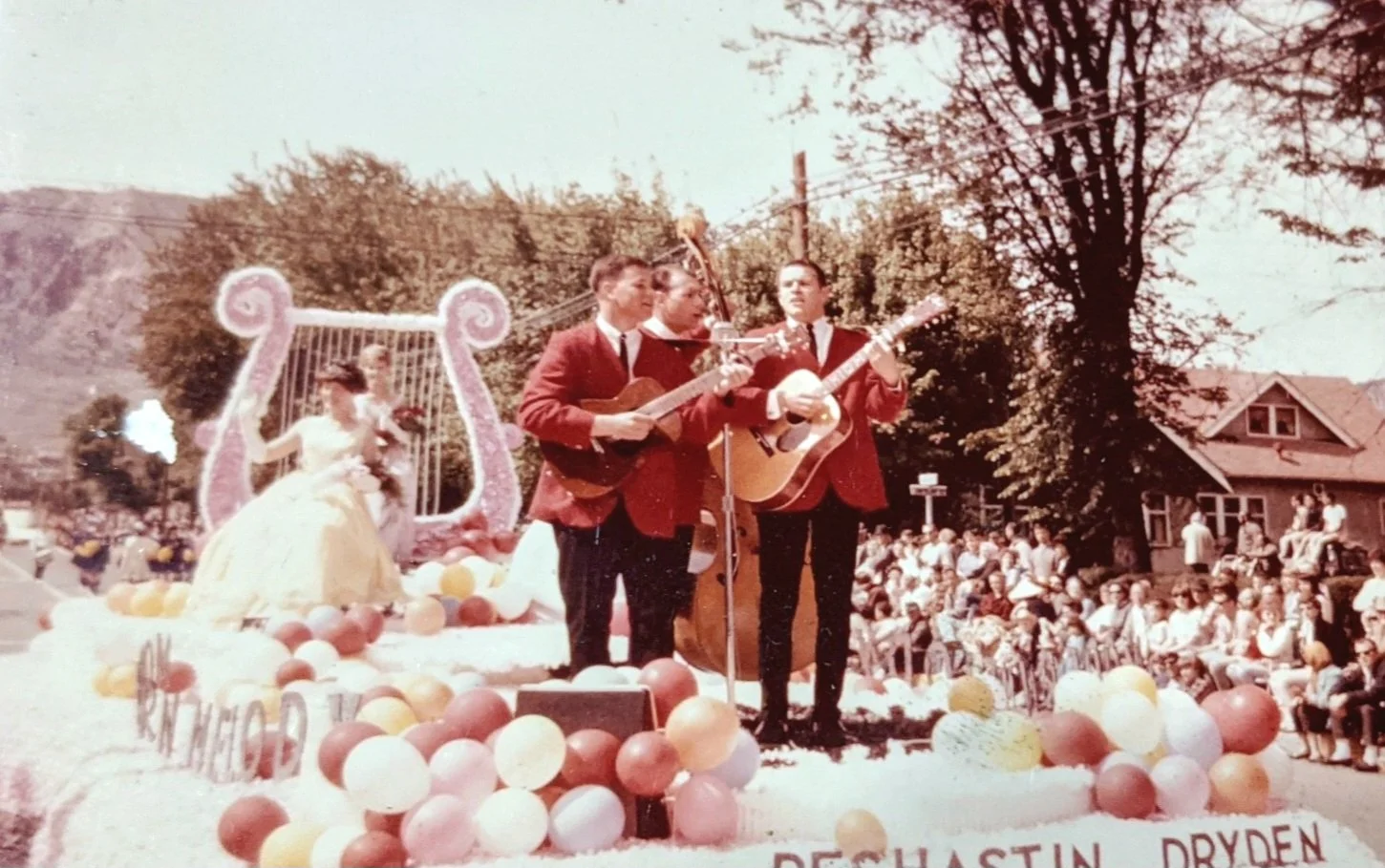
The trio performing on the Peshastin-Dryden Royalty float during the 1965 Apple Blossom Grand Parade. Credit: Richard Fuller
Before the group ever cut their records, Fuller recalled “we laid down a whole bunch of songs one weekend” during a session with Tom Richburg, a Cashmere pharmacist and amateur recording engineer.
“I don’t know (that) we knew our time was limited,” Fuller reflected. Kiehn and Fuller both graduated high school in ‘65, and Davis followed in ‘66.
In the spring of 1967, just before they would part ways, the group drove to Seattle and recorded a batch of songs at the Camelot Records recording studio. The majority of the tunes they recorded that day were done in one take. Davis’ father was financing the recording session, so the group called him for approval before any second take was started. One of the four songs released from the session, “Across the Sea,” is a Brothers Four composition, one of the largest folk groups in the world at that time, a group coincidentally featuring a 1955 Wenatchee High School graduate, John Paine.
Days after their Camelot session, The Yorktowne Singers played their final show, a hometown gig, for the Peshastin Woman’s Club. A local newspaper wrote about the occasion, mentioning the performance of a Kingston Trio song “Where I’m Bound,” that the group had recorded days prior in Seattle, “Few dry eyes were visible in the vast audience as the boys sang their last number, ‘Can’t help wonderin’ where I’m goin’, can’t help wonderin’ where I’ll be.’ ”
Davis had been drafted, leaving the following week to begin his four years of service in the U.S. Coast Guard. For the majority of his first year, he was stationed at a remote transmitting station near Port Clarence, Alaska, working as a radio dispatcher.
After completing his service, he returned to Central Washington to start a family, finding work with his father’s Davis Masonry Construction Company, later working as a dispatcher for the Chelan County Sheriff’s Office.
Kiehn had been helping commentate KUEN broadcasts of local sporting events, something he started in high school, after injuries sidelined him from playing football and basketball. While studying at Wenatchee Valley College, Kiehn worked at KUEN, later going to broadcasting school in Wisconsin, eventually finding work at a radio station in Alaska. He ultimately settled in Chico, California, opening an advertising agency. To avoid confusion with the pronunciation of his last name (pronounced ‘Keen’), he adopted the last name King, for his professional endeavors, a moniker he still employs.
Fuller went to the University of Oregon after high school, later teaching Piano and Music History at Linfield College in McMinnville, Oregon. For 40 years now, he has lived in Vienna, Austria. Fuller has gained significant notoriety, specializing in the fortepiano, an 18th Century predecessor to the modern grand piano, the instrument used by several classical composers.
Austria has a “pretty lively and sophisticated music scene here.” he shared with me. “The state radio station would record and broadcast performances, and even pay musicians for the service.” Fuller has amassed a very large recording discography over his career, an array of CDs and vinyl, released by a range of European labels.
Fuller had to take a two year break from music, after catching covid twice, and dealing with some other health problems. He’s back to working on new programs now, some chamber music and some solo. He’s “back to practicing everyday.”
Davis passed away in 2012, at the age of 63. He had lived in Cashmere since returning from his service in 1971. Kiehn shared, “After a disabling accident, he spent his remaining years enjoying his children and music, especially of The Yorktowne Singers.”
Through my interviews with both surviving Yorktowne Singers, I was sent a joint write-up about Davis’ involvement in the group, to give him his proper due, since he couldn’t tell his own story. Along with newspaper clippings and Fuller and Kiehn’s contributions, I was able to piece together what Davis might’ve shared with me. The trio haven’t performed together in nearly 60 years, but the statement, typed out by Kiehn, ended this way: “He was one of us... always will be.”
The folk scene in Central Washington was ripe with activity throughout the 1960s. Early in the decade, Wenatchee’s Danny O’Keefe and Chelan’s Alice Stuart both left the Pacific Northwest to further their music careers, while groups like New Folk, Take Three, and The Gordon Ohme Trio, are commonly remembered as favorite acts from the region.
Aided potentially by the rarity of their recordings, The Yorktowne Singers have been omitted, up to this point, in the nostalgic discussion of groups from the area. Unless you were hip to the folk scene here 60 years back, or a Peshastin-Dryden High School graduate, the music made by The Yorktowne Singers wasn’t on any of our radars.
Earlier this year, Fuller’s son, Nick, uploaded the group’s material to YouTube, both from the Camelot session and the Richburg recordings. Nick also made a Facebook page to collect stories and ephemera related to the trio. Searching “The Yorktowne Singers” on either platform will get you there.